
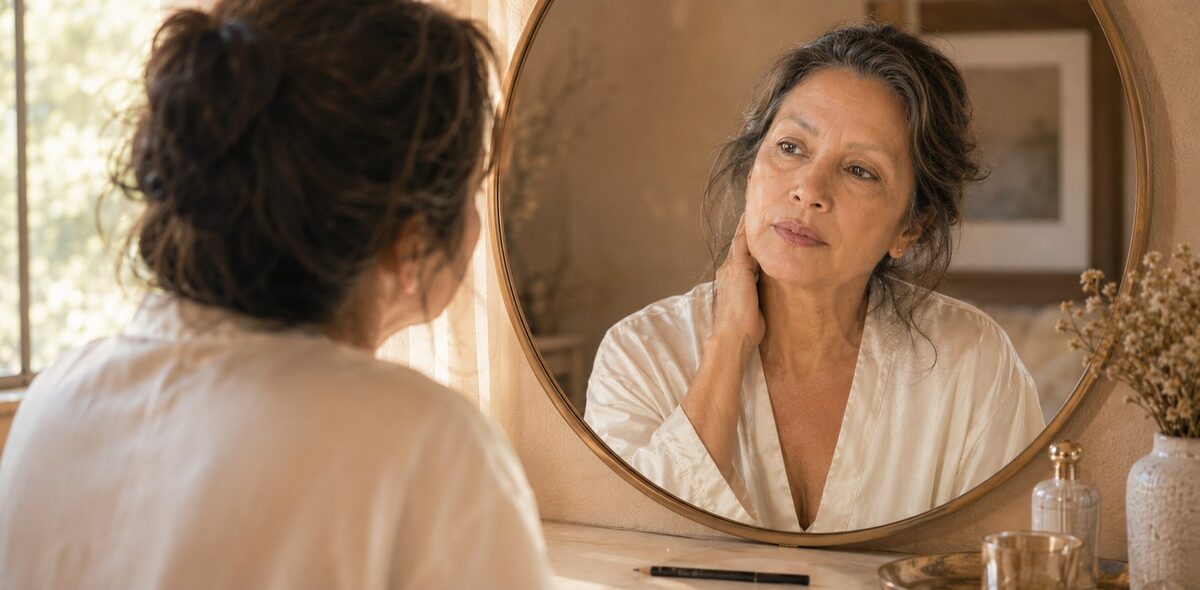
You said you'd never do it again.
Maybe it was the shape — brows that never quite looked like yours, that sat a little too high or a little too straight and changed the way your face read entirely. Maybe it was the color — something that started off fine and slowly turned into a gray or blue tone you've been quietly mortified by for two years. Maybe it was the experience itself — a rushed consultation, a result that looked nothing like what you were shown, a follow-up appointment that didn't help.
Whatever happened, you left that experience with a very clear decision: permanent makeup was not for you. You'd tried it. It hadn't worked. You were done.
And yet here you are.
Which means some part of you is still wondering — is there a version of this that could actually work for me? The answer, in most cases, is yes. But the path to that answer starts with understanding what went wrong the first time, and why the second experience doesn't have to go the same way.
What Most Bad PMU Experiences Have in Common
In seven years of working with clients across the East Valley — including a lot of correction clients who came to us after difficult experiences elsewhere — I've noticed that bad PMU outcomes rarely happen because permanent makeup doesn't work. They happen because of specific, preventable errors that had nothing to do with the client and everything to do with the artist or the process.
The consultation was too short or too surface-level. A thorough PMU consultation takes time. It involves looking closely at your existing brows, mapping a shape on your face before anything is marked, discussing your preferences in detail, and being honest about what's realistic for your specific skin and features. When that conversation is rushed — or skipped entirely — the results reflect it.
The shape was designed for someone else's face. Brow shape is not one-size-fits-all. A shape that's trending on Instagram, or that looks stunning on a client with completely different bone structure and features, can look wrong — even subtly wrong — on you. The best artists design brows that are specific to your face, not brows they reproduce on everyone.
The wrong pigment was used for your skin. Pigment selection is one of the most technically demanding parts of permanent makeup. The color that goes into your skin is not the color you'll heal with — it interacts with your undertones, your skin's chemistry, and how that particular pigment formula behaves over time. Artists without deep experience in color theory often underestimate this, and the result shows up six to eighteen months later as a gray, blue, orange, or ashy tone.
The technique didn't match the skin type. Microblading on oily or mature skin. Pigment implanted too deep. Strokes that were too close together. There are a dozen technical decisions made during a PMU application that require genuine expertise, and when those decisions are wrong, the results are wrong — often in ways that don't become fully apparent until the brows have healed and settled.
None of these are failures you caused. They are failures of experience, training, or care. And recognizing that matters — because if what went wrong wasn't about you or your skin, then there's no reason to believe the second time has to go the same way.
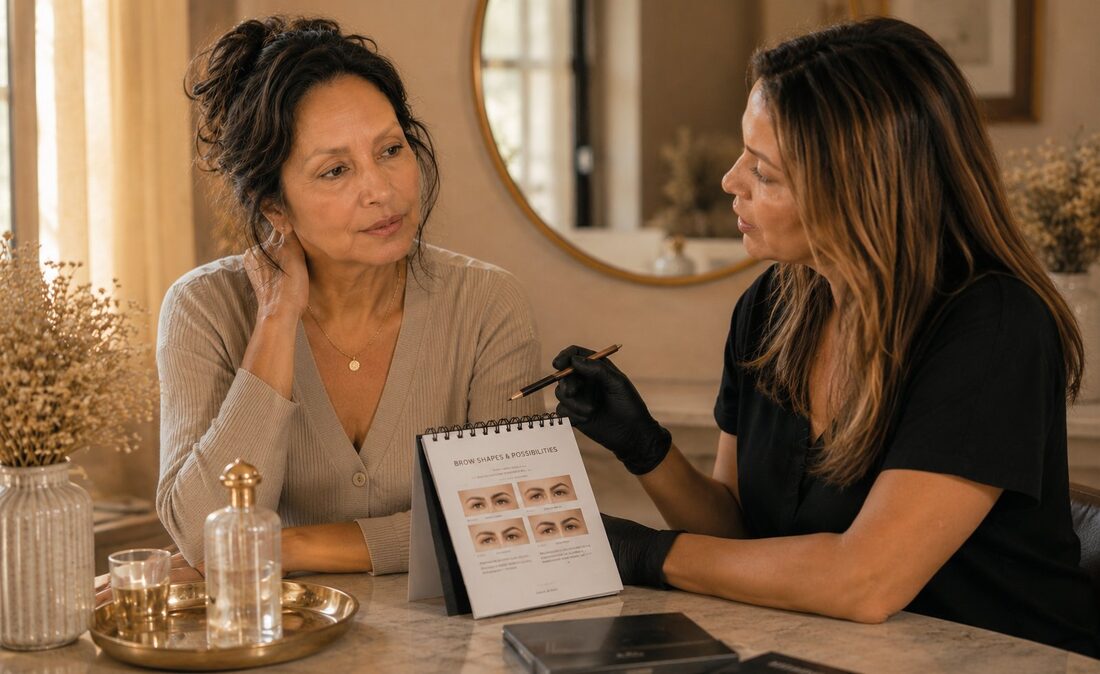
A correction consultation starts with your history — what was done, what went wrong, and what's actually possible from here.
What Correction Actually Looks Like
If you have existing permanent makeup that you're unhappy with, the path forward depends on what your brows actually look like right now. There are a few different scenarios.
If your brows have faded significantly and you're mostly unhappy with the color or shape but the pigment isn't heavily saturated, it's sometimes possible to work directly over the existing brows with fresh, correctly chosen pigment. This is the simplest correction path — fewer sessions, faster results, lower investment.
If your brows have shifted to an unwanted color — gray, blue, orange, or anything that doesn't look like brown — the existing pigment needs to be addressed before new color can be applied. Depending on the severity, this may involve a color neutralization approach, or it may require lightening sessions to reduce the existing pigment first.
If the shape is significantly wrong — brows that are too high, too arched, too straight, or simply not designed for your face — correction is more involved. Getting the shape right again may require removing or significantly fading the existing work before redesigning from a clean base.
If the pigment is heavily saturated — dark, dense, and clearly visible even under makeup — lightening or removal sessions will almost certainly be part of the process. At Kiss Kreations, we use magnetic tattoo removal developed by Linda Paradis, a technique designed specifically for cosmetic tattoo work. It's gentler than laser and effective at reducing existing PMU pigment in preparation for correction.
What all of these paths have in common is this: correction is not just a fresh appointment with a different artist. It's a process, and it requires honesty about what's involved, how long it will take, and what the investment looks like. We don't promise a single-session fix for work that needs real attention — but we do promise that most brows can be significantly improved, and many can be transformed completely.
Why the Second Time Is Different
This is the question that matters most for anyone who had a difficult first experience: what actually makes the second time different?
The answer is specificity. A correction consultation isn't a repeat of your first consultation. It starts with what you already have — the existing pigment, the existing shape, the history of what was done and how your skin responded — and builds a plan around that reality rather than starting from scratch.
It also starts from a different place emotionally. You are not a first-time client anymore. You know what you don't want. You have specific things you're correcting toward, not just a vague idea of "better brows." That clarity is actually an advantage — it makes for a much more precise and intentional result.
The other thing that changes is the artist. Not every PMU artist has the skills or the experience to handle correction work well. Fresh application and correction work are genuinely different disciplines. A correction client requires someone who understands color theory deeply enough to neutralize unwanted tones, who has enough technical experience to make sound decisions about depth and saturation, and who is honest enough to tell you when a result is going to take four sessions instead of one.
If your first experience was with someone who was earlier in their career, or with a studio where PMU wasn't the primary focus, the difference between that and a specialist isn't small. It's the entire outcome.
What to Look For This Time
Before you book another PMU appointment — whether for correction or for a fresh start after your existing work has faded — there are specific things worth asking and looking for.
Ask to see healed correction results specifically. Fresh before-and-afters are beautiful, but they don't tell you how the work holds up over time or how complex cases were handled. Healed correction photos — showing the existing problem and the finished, settled result — are far more informative.
Ask about their removal and lightening techniques. If your existing pigment needs to be addressed before new work can be done, the artist should have a clear, established approach to that — not a vague promise that they'll "work with what's there." Know what technique will be used, how many sessions to expect, and what the healing process looks like.
Make sure the consultation includes a shape mapping. Before anything is committed to your skin — even a pencil mark — you should be able to see the proposed shape on your face, approve it completely, and understand why each decision was made. If a consultation moves too fast for that, the appointment is moving too fast.
Be honest about your history. Tell your artist everything — every session, every artist, every product you've used over your brows, every reaction or unexpected result. The more context they have, the better the assessment.
At our Tempe studio, we build correction consultations around exactly these conversations. We don't start from a template — we start from your specific brows, your specific history, and what you actually want your face to look like when this is over.
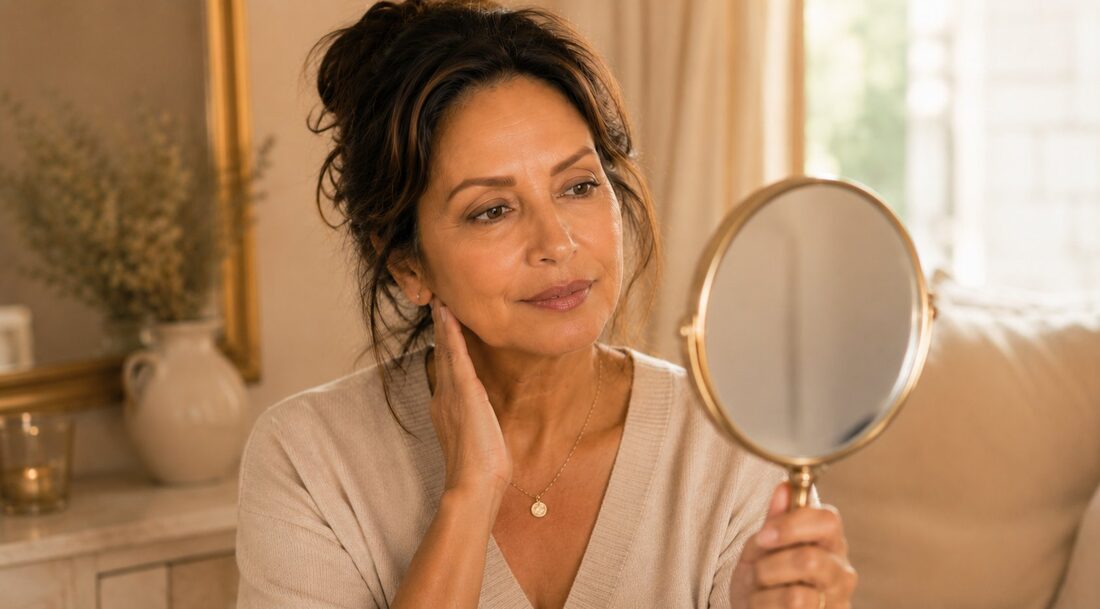
The mirror moment — quiet, not dramatic. Just a woman looking at her face and feeling like herself again.
A Client Story
Sandra came to us from Gilbert at 59, and she was very clear from the start: she had zero interest in getting permanent brows again. She'd had them done five years earlier. They'd healed wrong. The shape had been too angular for her face, and the color had shifted to a grayish tone within two years. She'd spent three years covering them with tinted brow gel before she finally decided to see if anything could be done.
"I'm not here to get new brows," she told me at the consultation. "I'm here to find out if these can be fixed, because I've been living with this and I'm exhausted."
We looked at her brows together. The pigment was moderately saturated — not the heaviest case we'd seen, but enough that we recommended two lightening sessions before new work. We also showed her a mapped shape — softer arch, more natural tail — that was designed specifically for her bone structure rather than a standard template.
She came back for her first lightening session. Then her second. Then her fresh application, with a warm, iron oxide-based pigment selected specifically for her skin tone. Then her touch-up.
At the touch-up appointment she arrived early. She'd already texted us a photo that morning — her brows in natural light, no product on them. The message with it read: "I actually looked in the mirror this morning and smiled. That hasn't happened in a long time."
That's what a second chance looks like when it's done right.
Frequently Asked Questions
Can bad permanent eyebrows be fixed?
In most cases, yes. Whether your brows have shifted color, lost their shape, or were never quite right to begin with, there are correction paths available. The approach depends on how saturated the existing pigment is, what color it has shifted to, and what your skin looks like underneath. Very few cases are truly beyond correction — but an honest in-person assessment is the only way to know exactly what yours needs.
How do I find a good PMU correction artist in Tempe?
Look for someone who specializes in correction work specifically — not just someone who also does it. Ask to see healed correction results. Ask about their removal techniques and how they approach color neutralization. In Arizona, there's no state PMU licensing requirement, so experience and a verifiable track record matter more than credentials. The artist should be able to explain clearly what they see in your brows and what they'd do about it before you commit to anything.
How much does PMU correction cost?
Correction starts at $700 and goes up depending on what your brows need. If tattoo removal or lightening sessions are required before new work can begin, the total investment will be higher — removal adds both time and sessions to the process. We don't quote correction pricing without seeing your brows in person, because every case is genuinely different.
How long does PMU correction take?
It depends on what your brows need. Straightforward color correction over lightly pigmented, faded brows can sometimes be done in one to two sessions. More complex corrections requiring lightening first typically involve multiple sessions spaced four to six weeks apart, followed by a fresh application and a touch-up. Most clients see their final result within three to six months of starting the process.
What if my permanent brows were done years ago and are very faded?
Heavily faded brows are sometimes the easiest correction cases, because the existing pigment isn't competing with new work as strongly. If the color has faded to the point where it's barely visible, it may be possible to simply apply fresh, correctly chosen pigment over it. If the old pigment still has enough color to interfere — even when it looks faded to you — we'll let you know and recommend the appropriate approach. The only way to assess this accurately is in person.
Is PMU correction worth it?
For most people who are living with brows they're actively unhappy with — covering them with makeup every day, avoiding photos, feeling self-conscious in a way that's quietly exhausting — the answer is yes. Correction is more involved than a fresh application, and it requires patience. But the result of waking up with brows you actually want, after years of managing ones you don't, is something our correction clients describe as far exceeding what they expected.
One Bad Experience Doesn't Have to Be the End
The women who come to us for correction work are some of the most skeptical clients we see. They've been disappointed before. They've lowered their expectations. They're not sure they trust the process anymore.
Our studio is in Tempe, and we work with correction clients from across the East Valley — Chandler, Gilbert, Mesa, Scottsdale, Queen Creek, Ahwatukee, and beyond. If you've been living with brows you don't love and you're ready to find out what's actually possible, come in. Let's look at them together.