It's a reasonable question. You're considering a procedure that involves a needle, pigment, and your face — and you want to know, honestly, whether it's safe.
The short answer is yes — permanent makeup is safe when it's performed correctly, by someone who knows what they're doing, using the right materials and proper technique. But that short answer leaves out the part that actually matters: what "correctly" means, what the real risks are, and how you protect yourself when choosing an artist in a state like Arizona where there is no licensing requirement for this work.
This is the honest version of that answer.
What Permanent Makeup Actually Involves
Permanent makeup — whether powder brows, nano hairstrokes, or combination brows — is a cosmetic tattooing procedure. A digital machine with a fine needle deposits pigment into the upper layer of the dermis, the layer just below the surface of the skin. This is shallower than a body tattoo, which is part of what makes PMU semi-permanent rather than truly permanent.
Because the procedure involves breaking the skin barrier, it carries the same general category of considerations as any other skin procedure: cleanliness of the environment, sterility of the equipment, quality of the materials, and the skill of the person performing it. None of these are reasons not to do it. They're reasons to choose carefully.
The Real Risks — What They Are and How Common They Actually Are
Permanent makeup has a small set of real risks. Understanding them clearly is more useful than either dismissing them or being alarmed by them.
Infection. Any procedure that breaks the skin creates a theoretical risk of infection. In practice, infection from professional PMU is rare — it typically occurs when aftercare instructions aren't followed (touching the area with unwashed hands, getting it wet too early, picking at healing skin) or, less commonly, when the studio environment or equipment isn't properly sanitized. A studio using single-use, sterile needles for every client and maintaining a clean workspace eliminates nearly all of this risk on the professional side. The rest is in your hands during healing.
Allergic reaction. True allergic reactions to PMU pigment are uncommon, particularly when cosmetic-grade iron oxide pigments are used. Iron oxide pigments are among the most biocompatible colorants available and are well-tolerated by the vast majority of skin types. At Kiss Kreations, we perform a patch test during every consultation — applying a small amount of pigment to the skin to confirm there is no reaction before proceeding with the full appointment. In our years of practice we have never had a client experience an allergic reaction, but the possibility always exists, and we take that seriously. The patch test is our standard, not an exception.
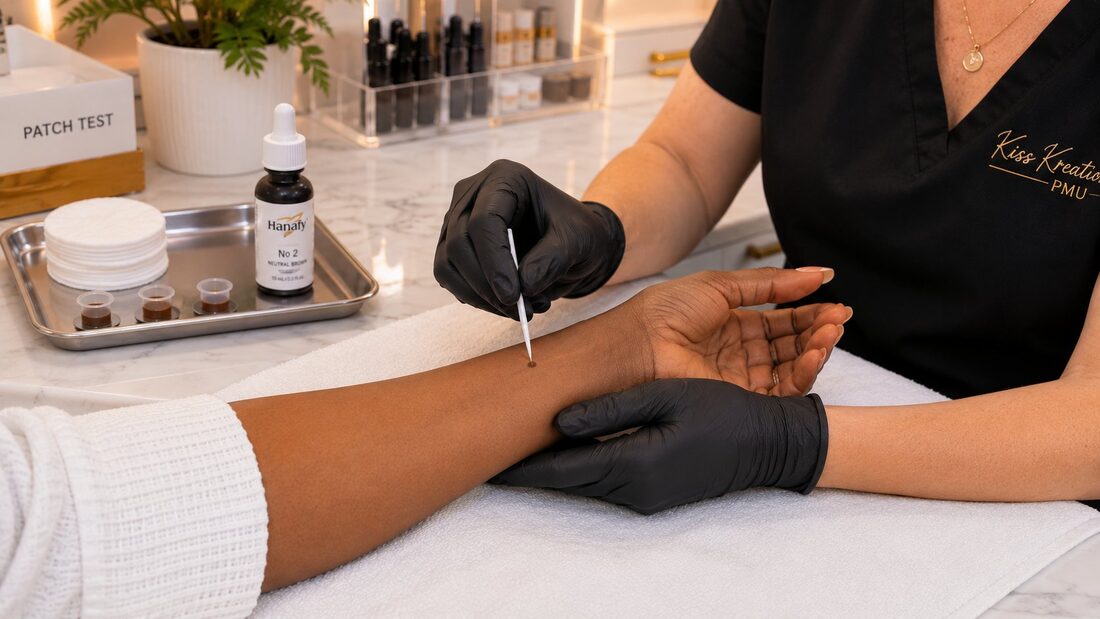
The patch test — a small amount of pigment applied at consultation to confirm there is no reaction. Our standard for every client, every time.
Unsatisfactory results. This is not a safety risk in the medical sense, but it is the most common negative outcome of PMU — and it's worth naming honestly. Brows that heal wrong, colors that shift unexpectedly, shapes that don't suit the face — these are outcomes that happen when the artist doesn't have sufficient experience or skill. They're not dangerous, but they can require correction work that costs significantly more than the original procedure. Choosing well the first time is the most effective way to avoid this.
Color shift over time. When the wrong type of pigment is used — particularly carbon-based or black pigments that aren't designed to break down cleanly — the color can shift to gray, blue, or green tones over months and years. This isn't a safety issue, but it's a quality issue that has become widespread enough to mention in any honest discussion of PMU risks. It's entirely avoidable with the right pigment selection.
MRI considerations. Iron oxide pigments can theoretically cause a mild warming sensation during MRI scans. This is generally considered a minor consideration — most radiologists are aware of cosmetic tattoos and adjust accordingly. If you have an MRI scheduled, mention your permanent makeup to the technician. It's rarely a practical issue but worth knowing.
What Makes Permanent Makeup Safer
The factors that reduce risk in permanent makeup are straightforward — and they're all things you can verify before you book.
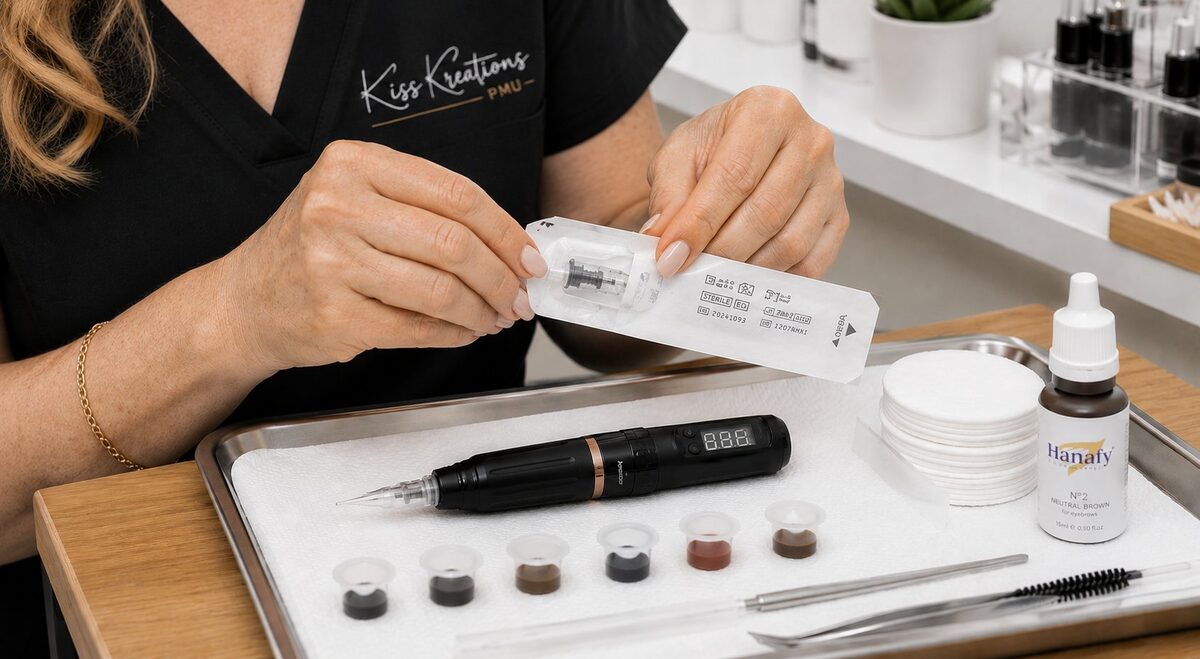
Single-use sterile needles. Every client should receive a new, sterile needle cartridge that has never been used before and will never be used again. This is non-negotiable. If you're not sure whether a studio practices this, ask directly. Any reputable studio will answer without hesitation.
Cosmetic-grade, vegan iron oxide pigments. The pigments we use at Kiss Kreations are cosmetic-grade, vegan, and not tested on animals — specifically formulated for the dermal layer of the skin. They're designed to break down cleanly and predictably over time. Body tattoo ink is not. An artist using proper PMU pigments — and who can tell you exactly what brand and formulation they use — is a meaningful indicator of the quality of their practice.
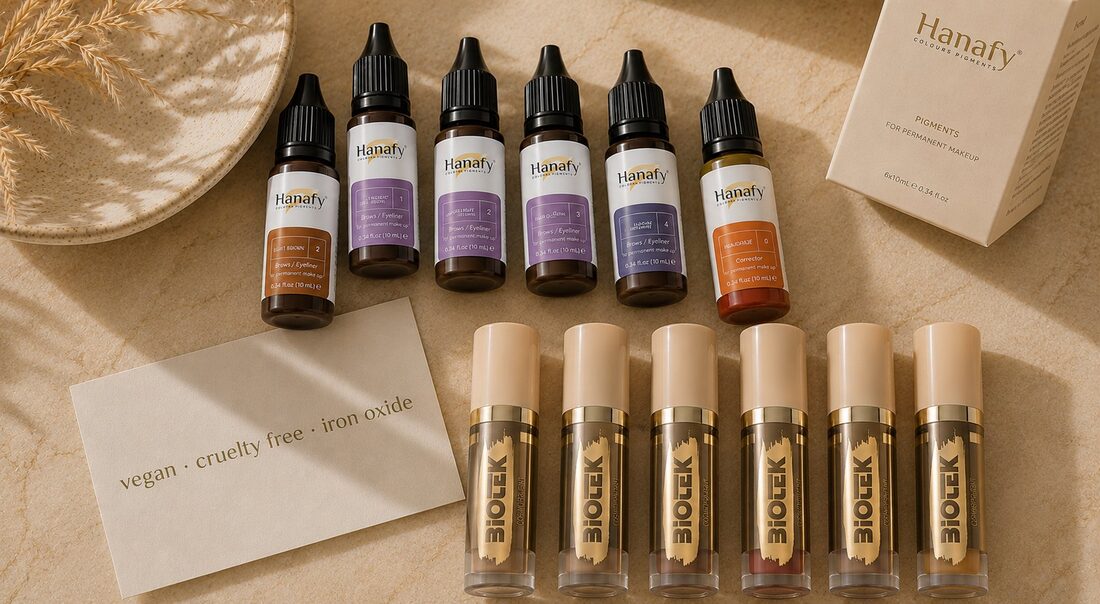
Vegan, cruelty-free, iron oxide pigments — specifically formulated for permanent makeup, never body tattoo ink.
A clean, dedicated studio space. PMU should be performed in a clean, professional environment — not a back room of a nail salon or a home setup that serves multiple purposes. This doesn't mean it needs to look like a medical facility, but it should be visibly clean, organized, and clearly set up for this specific kind of work.
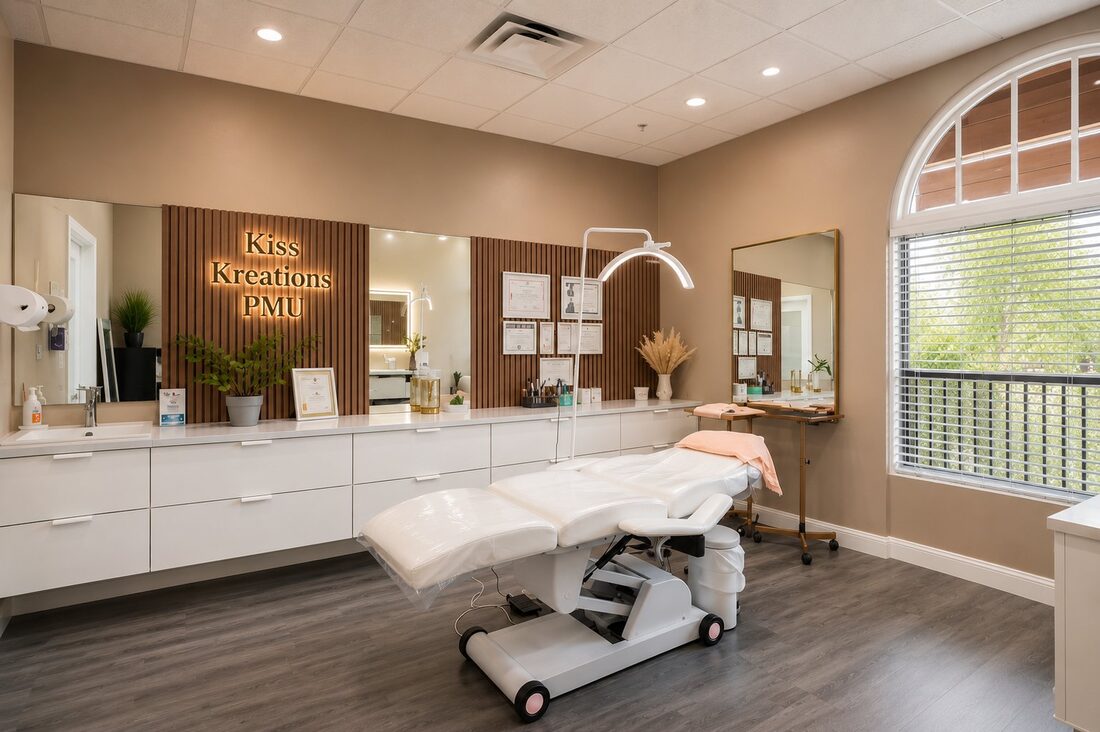
Our Tempe studio at 123 E. Baseline Rd — a dedicated, professional space built specifically for this work.
Genuine experience. Technique matters enormously in permanent makeup. Pigment depth, pressure consistency, needle speed, color theory — these are skills that develop over time and across many clients. An artist who has worked on hundreds or thousands of clients has encountered and navigated the variations in skin type, healing response, and color behavior that a newer artist simply hasn't seen yet. Experience is one of the most meaningful safety factors in this industry.
Transparent practices. A trustworthy artist will answer your questions directly. They'll tell you what pigments they use, how long they've been practicing, how many clients they've worked on, and what their aftercare protocols are. They'll show you healed results — not just fresh work from right after the appointment. Transparency about all of these things is itself a sign of a professional practice.
The Arizona Factor — Why It Matters More Here
In most states, permanent makeup artists are required to hold a specific license, complete a minimum number of training hours, and work under regulated conditions. Arizona is not one of those states.
Arizona does not currently require any state license to perform permanent makeup. There is no minimum training requirement, no supervised practice hours, no licensing exam. Anyone can offer PMU services in Arizona regardless of their background, training, or experience level.
This is not a criticism of any particular artist — it's simply the reality of how Arizona regulates this industry. And it means the research that might be optional in other states is genuinely necessary here.
Before you book with anyone in Tempe or anywhere across the East Valley, ask the questions that a licensing system would otherwise answer for you: How long have you been practicing? How many clients have you worked on? What training did you complete and with whom? Can you show me healed before-and-after photos — not just fresh work? What pigments do you use and why?
A skilled, experienced artist will welcome these questions. They'll have clear, specific answers. If any of these questions are deflected, minimized, or answered vaguely, that's the information you need.
What to Disclose at Your Consultation
Safety in permanent makeup is a two-way conversation. Your artist needs certain information to make sound decisions about whether and how to proceed — and a responsible artist will ask for it.
Be prepared to share: any skin conditions in or around the brow area, history of keloid scarring, bleeding disorders or conditions that affect clotting, autoimmune conditions, current medications (particularly blood thinners, retinoids, or iron supplements), history of allergic reactions to cosmetics or skincare, and whether you're pregnant or nursing.
Some of these factors are absolute contraindications — situations where PMU should not be performed at all. Others simply require adjustments to technique, timing, or aftercare. The only way your artist can make the right call is if they have the full picture, which means being thorough and honest at your consultation even about things that seem minor.
Aftercare — Your Role in a Safe Outcome
The procedure itself is only part of the equation. How your brows heal depends significantly on what you do in the days and weeks after your appointment.
Keep the area dry for the first ten days — no swimming, no steam rooms, no sweating directly over the brows if you can help it. Don't touch the brows with unwashed hands. Let any flaking or peeling happen naturally — picking at healing skin disrupts pigment retention and creates unnecessary risk of infection. Avoid sun exposure to the area while healing. And follow whatever specific aftercare instructions your artist provides, since protocols can vary slightly based on technique and individual skin type.
The healing process takes four to six weeks for the full result to settle. What looks intense or slightly uneven in the first week often looks completely different at week six. Patience during this period is genuinely part of getting a good outcome.
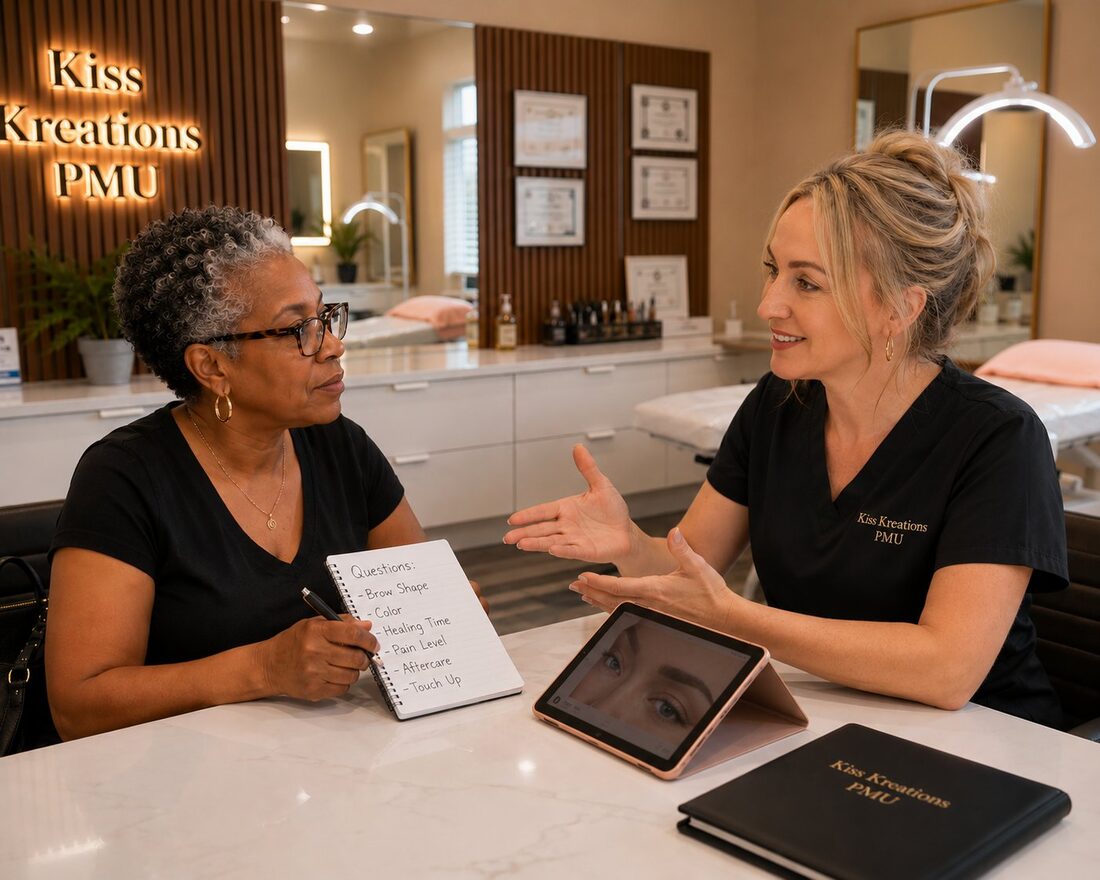
Every consultation is a real conversation. Bring your questions — all of them. That's exactly what this appointment is for.
A Client Story
Renee came to us from Gilbert at 64. She'd been researching permanent brows for almost a year — reading everything she could find, watching videos, going down rabbit holes at midnight — and the safety question was the one she kept coming back to. She had rosacea, mildly sensitive skin, and a history of reacting to some synthetic fragrances. She wasn't sure if that ruled her out.
At her consultation, we went through everything. Her rosacea was not active in the brow area. Her skin sensitivity was relevant to pigment selection — we opted for a pure iron oxide formula with no synthetic additives — but it wasn't a disqualifier. We talked through aftercare in detail, what the healing process would look like for her skin specifically, and what she should watch for.
She asked every question she'd saved up over that year of research. We answered all of them.
Her brows healed beautifully. No reaction, no complications, a result she described as exactly what she'd been hoping for. At her follow-up she said something that's stayed with us: "I just needed someone to actually talk to me like an adult about what this involves."
That's what a good consultation is for. And it's what every client deserves before they decide.
Frequently Asked Questions
Is permanent makeup safe?
Yes — when performed by an experienced artist using sterile single-use equipment and cosmetic-grade pigments, permanent makeup is a safe procedure with a well-established track record. Like any skin procedure, it carries a small set of manageable risks — primarily infection risk if aftercare isn't followed, and quality risks if the wrong pigments or technique are used. Choosing carefully reduces nearly all of these risks significantly.
What are the risks of permanent makeup?
The main risks are infection from improper aftercare or unsanitary technique, allergic reaction to pigment (uncommon with cosmetic-grade iron oxide formulas), unsatisfactory results from inexperienced application, and color shift over time when the wrong pigment type is used. Serious complications are rare when the procedure is performed correctly. The most common negative outcomes are quality-related rather than medical — which is why choosing an artist with verified experience matters so much.
Does Arizona require a license for permanent makeup?
No. Arizona does not require a state license to perform permanent makeup. There is no minimum training requirement or licensing exam. This makes it more important than in most states to do your own research before booking — asking specifically about years of experience, number of clients, training background, and requesting healed results to review. A skilled artist will welcome these questions.
Can I get permanent makeup if I have sensitive skin?
In most cases, yes. Sensitive skin is not an automatic disqualifier. At Kiss Kreations we use vegan, cruelty-free iron oxide pigments that are among the most biocompatible colorants available. We also perform a patch test at every consultation — applying a small amount of pigment to confirm there is no reaction before the full appointment. We have never had a client experience an allergic reaction, but we treat it as a real possibility and take every precaution accordingly. Disclose your full skin history at your consultation so we can make the right call together.
Is permanent makeup safe for people with medical conditions?
It depends on the condition. Active skin conditions in the brow area, bleeding disorders, certain autoimmune conditions, and some medications may affect whether PMU is appropriate or how it heals. Always disclose your full medical history at your consultation. A responsible artist will ask, and some situations may require clearance from your doctor before proceeding. This isn't a reason to assume you can't have it done — it's a reason to have an honest, thorough conversation first.
What should I look for to make sure permanent makeup is done safely?
Single-use sterile needle cartridges for every client. Cosmetic-grade iron oxide pigments — not body tattoo ink. A clean, dedicated studio space. An artist with significant verifiable experience who can show you healed results. Willingness to answer your questions directly and specifically. In Arizona, where there's no licensing requirement, these are the things you ask about yourself — and any trustworthy artist will have clear answers to all of them.
Safe PMU Starts With the Right Conversation
The question isn't really whether permanent makeup is safe in general. It's whether it will be safe for you, done by the right person, in the right environment, with the right materials. That's a question worth asking — and one that deserves a real answer before you book.
Our studio is in Tempe and we see clients from all across the East Valley — Chandler, Gilbert, Mesa, Scottsdale, Queen Creek, Ahwatukee, and beyond. Come in for a consultation and ask us everything. We mean that.