
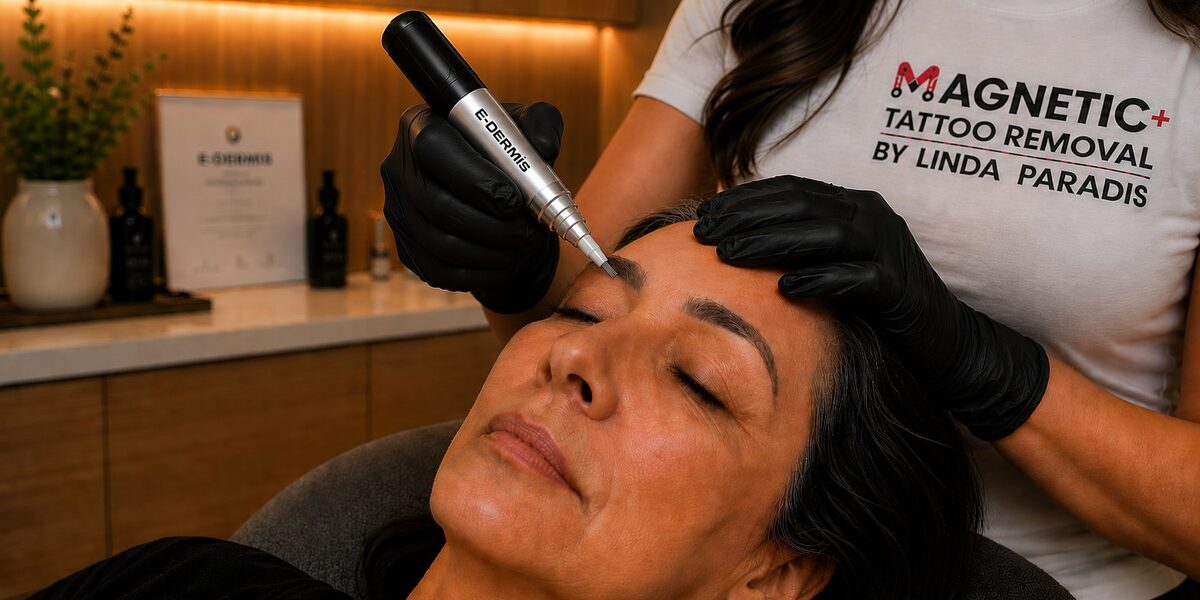
There are more reasons to want eyebrow tattoo removal or permanent makeup removal than most people realize — and more ways to do it than most people know about.
Maybe your microblading didn't hold the way it was supposed to and you want it removed before starting fresh. Maybe your brows healed wrong and the color shifted in a direction you never expected. Maybe the shape was never quite right and you've been living with it for years. Maybe your brows were done a decade ago and the style simply doesn't suit who you are anymore.
Whatever brought you here, you deserve a clear, honest answer about what your options actually are — what each method does, how it works, what the real tradeoffs are, and why we made the specific choice we did about which technique to offer at Kiss Kreations.
Why Eyebrow Tattoo Removal Is Different From Body Tattoo Removal
This distinction matters and is often overlooked. Permanent makeup and body tattoos are not the same thing — and the methods that work for one don't always work as well for the other.
Body tattoos are designed to last forever. The ink is deposited deep into the dermis, in high concentration, using pigments formulated for maximum longevity. Removal methods for body tattoos — particularly laser — are designed to break down that deep, dense pigment.
Permanent makeup is different. It sits in the upper dermis, shallower than a body tattoo. The pigments used in quality PMU work are cosmetic-grade iron oxide formulations, not body tattoo ink. They're designed to fade gradually over time. The skin around PMU brows is also more delicate — the tissue is thinner, closer to the eye, and more sensitive to heat and chemical trauma.
This means that the most aggressive removal methods — while effective for body tattoos — can be disproportionately harsh when applied to the delicate skin of the brow area.
The Four Main Removal Methods — Pros, Cons, and the Real Picture
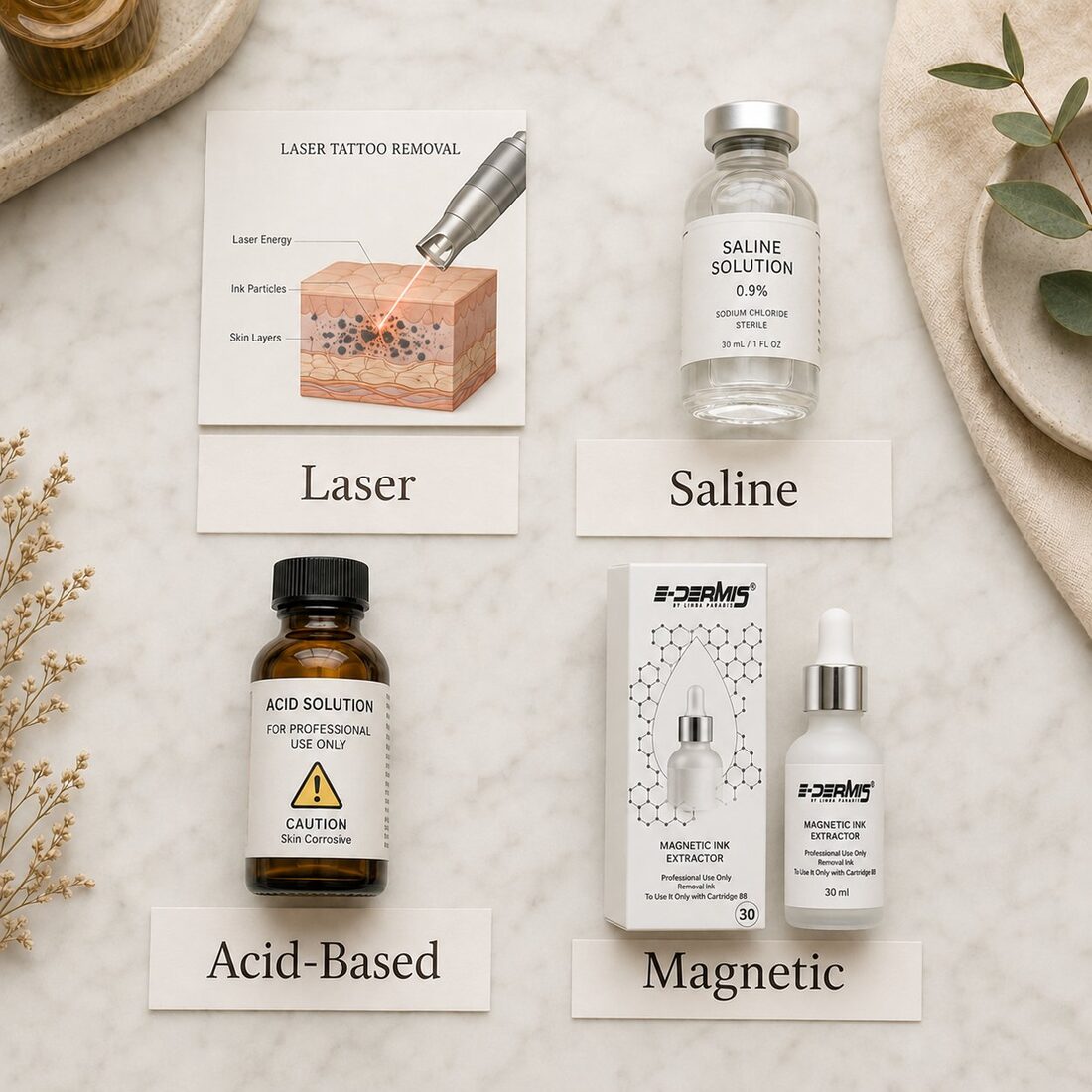
The four main methods used for eyebrow tattoo and permanent makeup removal. At Kiss Kreations, we use the magnetic technique — the only one built from the ground up for cosmetic tattoo removal.
Laser Tattoo Removal
Laser tattoo removal is the most well-known method and the one most people search for first. It works by directing concentrated light energy at the pigment, which absorbs the energy and shatters into fragments small enough for the body's immune system to clear away over time.
For body tattoos, laser tattoo removal is often effective. For eyebrow tattoo removal and permanent makeup specifically, the picture is more complicated. Laser struggles with warm-toned iron oxide pigments — the browns and tans most commonly used in professional PMU work. These pigments can paradoxically darken under laser treatment before they lighten. Laser also uses heat, which can cause burns and scarring on the thin, sensitive skin around the brows.
Saline Removal
Saline removal is one of the most widely used methods for microblading removal and PMU lightening. It uses a highly concentrated saline solution implanted into the skin using a PMU machine. The saline creates osmosis — drawing moisture, and with it pigment, upward toward the surface of the skin. Saline removal is gentler than laser and works on all pigment colors. The tradeoffs are that it can require multiple sessions and the process of drawing pigment to the surface causes temporary crusting during healing.
Acid-Based Removal
Acid-based removal methods work by introducing an acidic solution into the skin to break down pigment. They carry a higher risk profile — including burns and scarring — particularly if applied incorrectly. For the delicate brow area, we consider acid-based removal to carry more risk than the alternatives, and it is not a method we offer or recommend.
Magnetic Tattoo Removal — The Linda Paradis Technique
This is the method we use at Kiss Kreations, chosen deliberately after researching the full landscape of options. Magnetic tattoo removal was developed and patented by Linda Paradis, who received the Oscar of Best Innovation in Paris for this technique. It is used by more than 2,000 certified practitioners worldwide and is specifically designed for cosmetic tattoo removal.
The technique uses 300-Gauss non-invasive magnetic needles that work on the surface of the skin without penetrating the dermis. Because the needles don't go deep into the skin, there is no scarring, no need for anesthesia, and significantly reduced risk. Combined with the Tattoo Remoov solution — a specialized serum formulated from water and food-grade molecules — the technique draws pigment upward and out of the skin without chemical burning or thermal damage. It is non-toxic, works on all pigment colors, and is effective on all skin types and tones.
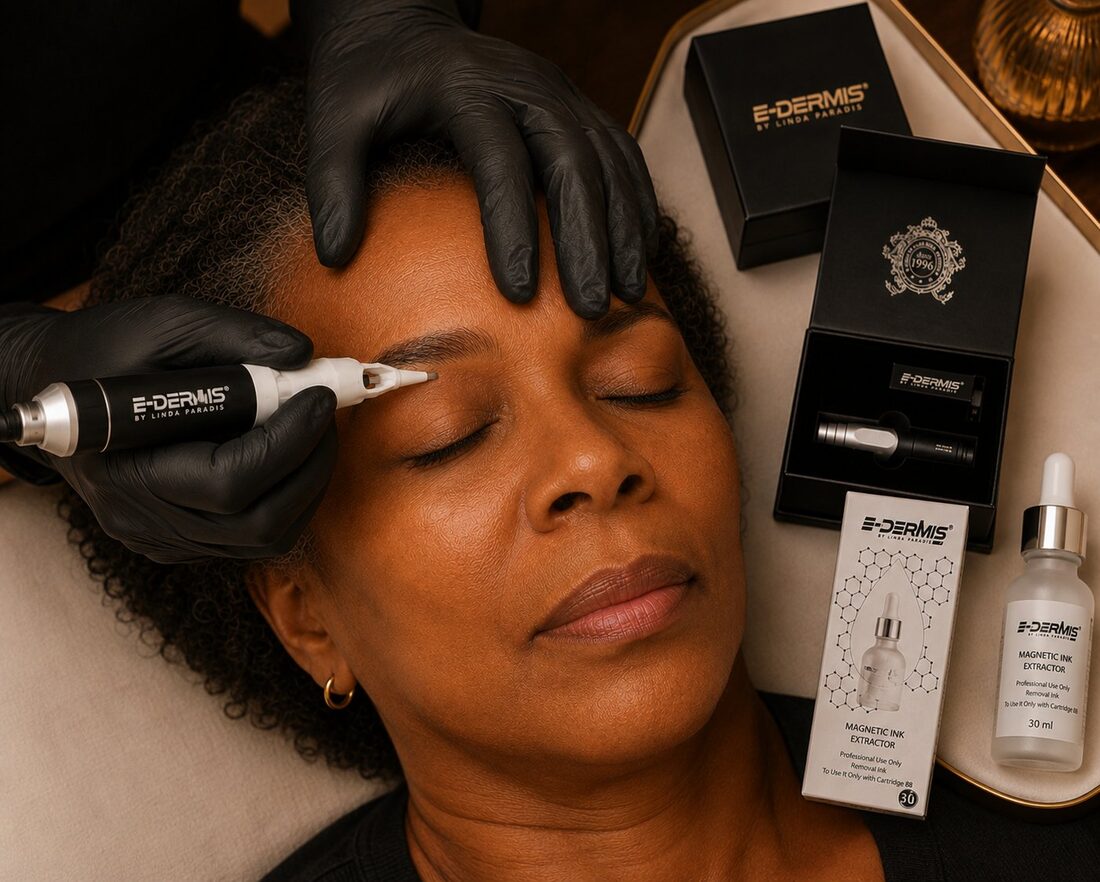
The E-Dermis device by Linda Paradis — the patented magnetic system used at Kiss Kreations. The 300-Gauss magnetic needles work on the surface of the skin without penetrating the dermis.
Skin Type Considerations — What Nobody Tells You Before You Book
One of the most important — and most overlooked — factors in permanent makeup removal is skin type. Not every removal method works equally well on every skin. In some cases, choosing the wrong method for your skin type doesn't just produce poor results. It can cause lasting damage.
Laser tattoo removal and darker skin tones. This is the most significant compatibility issue in the removal space. Laser works by targeting pigment with concentrated light energy. On darker skin tones — Fitzpatrick types IV through VI, which includes many Latina, Black, South Asian, and Middle Eastern women — laser can't always distinguish between the tattoo pigment and the melanin in the surrounding skin. The result can be hypopigmentation (permanent white patches) or hyperpigmentation (dark spots). Many reputable laser practitioners will decline to treat darker skin tones for exactly this reason. If you have a deeper complexion and you've been told laser is fine without any discussion of skin tone risk, that's worth taking seriously.
Laser tattoo removal and mature or thin skin. On mature skin — thinner, less elastic, slower to heal — the heat damage risk from laser is higher, and the potential for burns or scarring increases. This is one of the primary reasons we consider laser a poor first choice for the delicate brow area on women over 50.
Saline removal and dry or mature skin. On very dry or dehydrated skin, saline osmosis is less efficient, requiring more sessions. On mature skin, the healing process between sessions is slower, extending the timeline significantly.
Acid-based removal and all skin types. The risk is highest for darker skin tones — where chemical burns are more likely to leave permanent pigmentation changes — and for thin or mature skin where over-penetration and scarring risk is elevated. This is why we do not offer it.
Magnetic removal across all skin types. Because the magnetic needles work on the surface of the skin without penetrating the dermis, the risk profile is significantly lower across the board. Magnetic removal is effective on all skin tones — including darker complexions where laser carries real risk — and is gentler on mature and sensitive skin than any heat-based or chemical method. There are still situations that require caution — active skin conditions in the brow area, keloid-prone skin — but these are assessed at consultation and managed accordingly.
If you have a darker skin tone, mature skin, sensitive skin, or a history of reactions to cosmetic procedures, magnetic removal is almost always the most appropriate choice. It's not the most widely advertised option — laser gets the marketing budgets — but for the skin types we see most in our Tempe studio, it is the right one.
Magnetic removal is safe and effective on all skin tones — including deeper complexions where laser carries real risk of hyperpigmentation or hypopigmentation.
Side by Side: How the Methods Compare
| Method | How It Works | Scarring Risk | Safe for Darker Skin | Best For |
|---|---|---|---|---|
| Laser Tattoo Removal | Heat energy shatters pigment | Moderate — heat damage possible | Risk of hypo/hyperpigmentation | Dark body tattoo ink |
| Saline | Osmosis draws pigment to surface | Low to moderate | Yes | Lightly saturated or faded PMU |
| Acid-based | Chemical breaks down pigment | Higher — burn risk | Not recommended | Not recommended for brow area |
| Magnetic (Linda Paradis) | Magnetic needles + serum — no dermis penetration | Zero — guaranteed no scarring | Yes — all skin tones | PMU and cosmetic tattoo removal — all skin types |
Why We Chose Magnetic Removal at Kiss Kreations
When we evaluated removal methods, the choice came down to a straightforward question: which technique was designed for the work we actually do?
Laser tattoo removal was developed for body tattoos — dense, deep, dark. Adapting it to the shallow, delicate, iron-oxide pigment of PMU brows introduces risks that aren't inherent to the technique itself, but to the mismatch between the tool and the application. We see enough clients who have had PMU laser removal go wrong — particularly women with darker skin tones or mature skin — to know that this mismatch is real and consequential.
The magnetic technique is the only one built from the ground up for cosmetic tattoo removal. The needles don't penetrate the dermis. There's no heat. There's no chemical burning. The removal serum is food-grade and non-toxic. And Linda Paradis received the Oscar of Best Innovation in Paris specifically for this technique, now trusted by certified practitioners worldwide.
We're certified in the Linda Paradis technique because it aligns with how we think about everything else we do: choose the method that's right for the specific tissue you're working on.
What the Process Actually Looks Like
We start with an in-person assessment — reviewing your before-and-after goals, looking at the existing pigment in natural and studio light, evaluating the saturation and depth, and determining whether removal is the goal in itself or part of a larger correction plan.
Each removal session takes approximately 45 minutes to an hour. The magnetic needles work across the brow area in careful, systematic passes with the Tattoo Remoov solution applied throughout. There is no anesthesia required — most clients describe the sensation as mild and manageable, noticeably less intense than the original PMU procedure.
Sessions are spaced 3 to 5 weeks apart to allow the skin to fully recover between treatments. For color lightening in preparation for correction work, most clients need 3 to 6 sessions. Complete removal — required when the shape needs to be fully redesigned from scratch — may take additional sessions depending on how saturated and deep the existing pigment is.
Emergency Removal — When Something Goes Wrong Right Away
Not every removal client comes to us months or years after a procedure. Some come to us within hours.
Emergency removal is performed immediately after a PMU procedure when the client is unhappy with the result — the shape, the color, or both. It is one of the most time-sensitive situations in permanent makeup, and the window is narrow: emergency removal must be done within 72 hours of the original appointment.
Here's why timing matters so much. In the first 72 hours after a PMU procedure, the skin is still in the early stages of healing and has not fully closed. During this window, the body is actively drawing moisture to the surface — and that same process makes it possible to draw pigment upward and out. Magnetic removal during this window can lift a significant amount of ink before the skin seals it in permanently.
After 72 hours, as the skin closes and heals, emergency removal is no longer possible. At that point the only option is to wait — a minimum of 4 weeks for the skin to fully recover — before standard removal sessions can begin. The pigment that could have been lifted in those first three days will now require multiple sessions to address.
If you've just had permanent makeup done somewhere and something isn't right — the shape is off, the color is wrong, it's darker than you expected — contact us immediately. Don't wait to see how it heals. Don't assume it will look different once the swelling goes down. Time is the one thing you cannot get back in this situation.
Removal as Part of a Correction Plan
For many of our clients — particularly those coming in for microblading removal or correction after failed PMU — removal is not the end goal. It's the first step toward getting brows they actually love.
If your existing permanent makeup has a shape that needs to be redesigned, a color that has shifted significantly, or a saturation level too heavy to work over cleanly, removal sessions create the foundation for new work that looks intentional rather than layered over a problem.
We see removal and correction clients from all across the East Valley — Chandler, Gilbert, Mesa, Scottsdale, Queen Creek, Ahwatukee, and beyond — as well as from across Arizona and out of state. Clients travel to our Tempe studio specifically for the magnetic removal technique because it's not widely available. If you're not sure whether your situation calls for removal, correction, or both, the answer always starts with an in-person assessment.
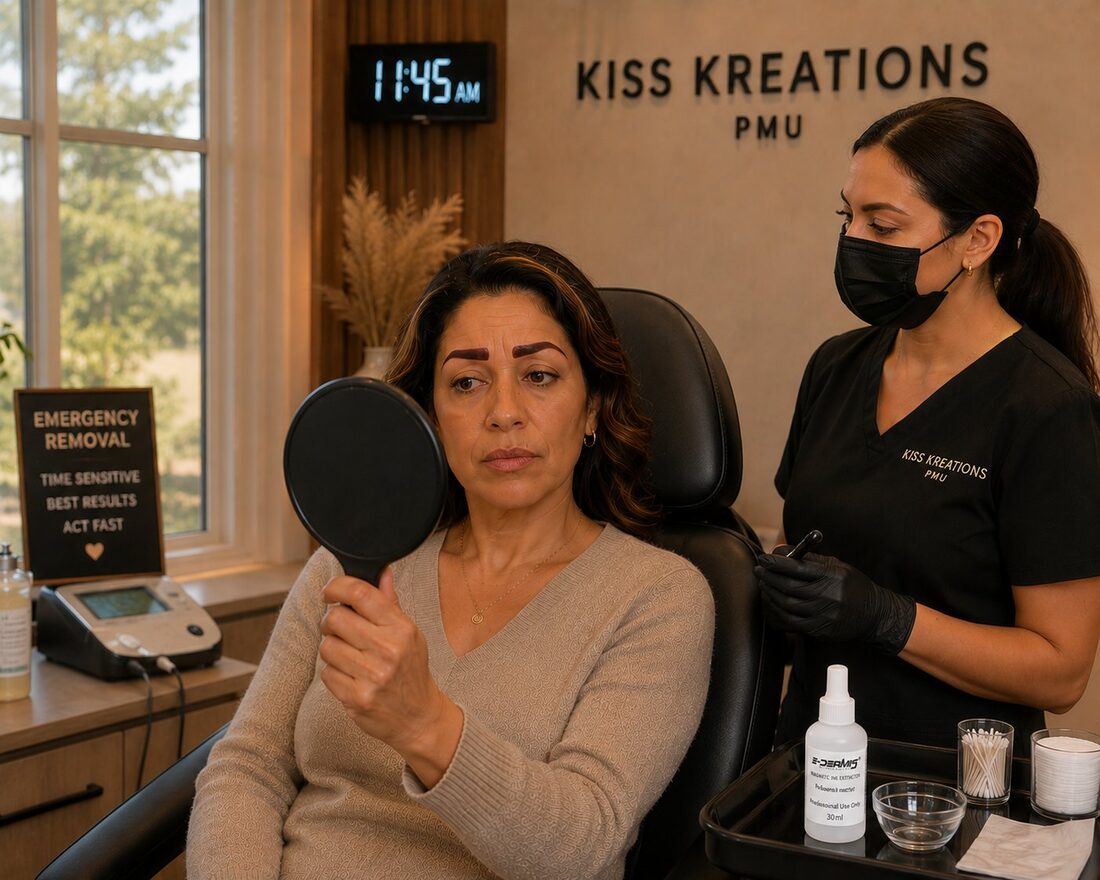
Many of our clients come to us frustrated with previous PMU work — color shifts, shape changes, or simply brows that no longer reflect who they are. The assessment is where we figure out what's actually possible.
A Client Story
Diane came to us from Queen Creek at 59 with brows she described as "a decade of bad decisions." She'd had permanent brows done at 48, touched up twice, and by the time she found us the original warm-brown color had shifted to a flat, slightly blue-gray tone with a shape she'd never fully liked. She'd been covering them with tinted brow gel every morning. She was tired of it.
At her assessment we looked at the before — the existing brows in natural light — and walked her through honestly what correction would involve. The saturation was significant. The shape needed to be redesigned. Working over what was there wasn't going to give her the result she wanted. She needed removal sessions first.
We completed three magnetic removal sessions over four months. With each session the pigment lifted gradually — the blue-gray tones surfacing and fading, the shape softening, the saturation reducing to a level we could work with cleanly.
Her fresh powder brow application came after the third session, once the skin had fully healed. We mapped a new shape — softer arch, designed specifically for her bone structure — and chose a warm iron oxide pigment matched to her undertones.
She sat up after her healed result appointment and looked in the mirror for a long time. Then: "These are actually my brows. These are just my face."
That's what removal makes possible. Not just erasing something. Starting over, correctly.
Frequently Asked Questions
Can permanent makeup be removed?
Yes. Permanent makeup can be removed or significantly lightened. The most appropriate method depends on the pigment type, depth, saturation, and condition of the skin. At Kiss Kreations we use the magnetic tattoo removal technique developed by Linda Paradis — a patented, non-laser, non-chemical method specifically designed for cosmetic tattoo removal. It causes no scarring and works on all pigment colors and skin types.
What is magnetic tattoo removal and how does it work?
Magnetic tattoo removal is a patented technique developed by Linda Paradis. It uses 300-Gauss non-invasive magnetic needles that work on the surface of the skin without penetrating the dermis, combined with a specialized non-toxic removal serum that draws pigment upward and out of the skin. No anesthesia is needed, there is zero risk of scarring, and it is effective on all colors and skin tones. It was specifically designed for cosmetic tattoo and PMU removal.
Is laser tattoo removal safe for darker skin tones?
This is one of the most important questions to ask before booking any removal procedure. Laser targets pigment with light energy — but on darker skin tones (Fitzpatrick types IV through VI, common in Latina, Black, South Asian, and Middle Eastern women), laser can struggle to distinguish between the tattoo pigment and the melanin in the surrounding skin. This can result in hypopigmentation (white patches) or hyperpigmentation (dark spots) that can be permanent. Many reputable laser providers will decline to treat darker skin tones for exactly this reason. Magnetic removal does not carry this risk and is safe and effective on all skin tones — making it a significantly better choice for women with darker complexions.
Does eyebrow tattoo removal hurt?
Does it hurt? With magnetic removal, most clients describe the sensation as mild — noticeably less intense than the original PMU procedure. No anesthesia is required. You may feel a light scratching or tingling sensation during the session. Compared to laser tattoo removal — which many clients describe as more intense and which requires numbing cream — magnetic removal is generally considered a much more comfortable experience.
How many sessions does permanent makeup removal take?
Sessions are spaced 3 to 5 weeks apart to allow full healing between treatments. For color lightening in preparation for correction work, most clients need 3 to 6 sessions. Complete removal — when the shape needs to be fully redesigned — may require additional sessions depending on how saturated and deep the pigment is. We give every client a realistic estimate at their assessment based on what we actually see in your brows.
Is removal always necessary before correction work?
Not always. When existing pigment is sufficiently faded and the saturation is manageable, it's often possible to apply new work directly over the existing PMU. Removal becomes necessary when the pigment is too saturated to work over cleanly, when the color shift is significant enough to interfere with new pigment, or when the shape needs to be redesigned from scratch. The assessment tells us which situation applies to your brows.
How much does permanent makeup removal cost in Tempe AZ?
Removal pricing depends on how many sessions are needed and whether removal is part of a larger correction plan. At Kiss Kreations, correction and removal plans start at $700. We don't quote removal pricing without seeing your brows in person — the cost reflects what your specific situation actually requires.
What is emergency PMU removal and how soon does it need to be done?
Emergency removal is performed immediately after a PMU procedure when the client is unhappy with the result — shape, color, or both. It must be done within 72 hours of the original appointment, while the skin is still in the early stages of healing and has not fully closed. The sooner it is done, the better — the fresher the pigment, the more ink can be lifted before the skin seals it in. During this window, magnetic removal can extract a significant amount of pigment because the skin's natural healing process is still drawing moisture to the surface. After 72 hours, as the skin closes, emergency removal is no longer possible. At that point you must wait a minimum of 4 weeks for the skin to fully heal before standard removal sessions can be performed. If you've just had permanent makeup done and something isn't right, contact us immediately — time matters.
Can magnetic tattoo removal be used if I've already had laser or saline removal?
Yes — in most cases. Magnetic removal can be performed on skin that has previously been treated with laser or saline, as long as the skin has fully healed from those prior sessions. Many clients come to us after laser or saline removal that didn't fully complete the job, and magnetic removal has successfully continued the lightening process. The assessment will look at the current condition of the skin and the remaining pigment to confirm the timing is right and that the tissue is healthy enough to proceed.
The Right Removal Makes the Right Result Possible
Removal isn't the end of the story — it's what makes the right beginning possible. Whether you want a clean slate, a color correction, or a complete redesign, the process starts with an honest look at what you have and a clear plan for where you're going.
Our studio is in Tempe. We see clients from all across the East Valley, from across Arizona, and from out of state — many traveling specifically for the magnetic removal technique. Come in and let's look at your brows together.